DETROIT DIESEL 23520734 Mechanical Oil Temperature Gauge 120-340
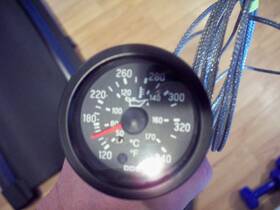
( Brand: Detroit Diesel ), ( Manufacturer Part Number: 23520734 ), ( Interchangeable Part Number: 23539612 ), ( Type: Temperature Gauge ), ( Country Of Origin: United States )
Review DETROIT DIESEL Mechanical Oil Temperature Gauge 120-340 Degree New
The **Detroit Diesel 23520734 Mechanical Oil Temperature Gauge (120 340 F)** is a robust, high-performance instrument designed specifically for heavy-duty diesel engines, ensuring precise monitoring of oil temperature to maintain optimal operating conditions and prevent costly mechanical failures. This gauge features a durable mechanical design, built to withstand the harsh environments found in commercial trucks, construction equipment, marine applications, and industrial machinery. The gauge s robust construction includes a sturdy metal housing and a reliable bimetallic sensing element, which responds quickly and accurately to temperature fluctuations, providing real-time feedback to the operator. With a clear, easy-to-read dial marked from **120 F to 340 F**, it offers a wide range of measurement capability, allowing for comprehensive monitoring of oil temperature across varying operating conditions whether during cold starts, high-load operations, or prolonged idling. The gauge s mechanical operation eliminates the risk of electronic malfunctions, ensuring dependable performance even in extreme temperatures or under electrical interference. Ideal for integration into existing Detroit Diesel engines or compatible with other heavy-duty applications, this gauge is a critical component for fleet managers, mechanics, and operators who prioritize engine longevity and efficiency. Its rugged build and straightforward design make it a trusted choice for professionals who demand reliability in demanding environments.
**Pros and Cons of buying a Detroit Diesel 23520734 Mechanical Oil Temperature Gauge (120-340 F)**
### **Pros:**1. **Compatibility** This gauge is specifically designed for Detroit Diesel engines, ensuring proper integration with the engine s electrical and mechanical systems. It is commonly used in heavy-duty applications like trucks, buses, and industrial equipment.
2. **Durability** Mechanical gauges like this one are built to withstand harsh environments, including vibrations, extreme temperatures, and frequent use. They are less prone to electronic failures compared to digital alternatives.
3. **Reliability** Mechanical gauges have fewer moving parts than electronic ones, reducing the risk of malfunction over time. They do not rely on sensors or computer systems, making them less susceptible to software or electrical issues.
4. **Simplicity** The design is straightforward, with no complex wiring or calibration requirements. If the gauge fails, it is often easier and cheaper to replace than an electronic system.
5. **Cost-Effective** Mechanical gauges are generally less expensive to purchase and maintain than their digital counterparts. Replacement parts are widely available, and labor costs for installation or repair are lower.
6. **Visual Clarity** The analog needle provides a quick, easy-to-read indication of oil temperature, allowing operators to monitor conditions at a glance without needing additional tools.
7. **Off-Grid Functionality** Unlike electronic gauges that may require power or calibration, this mechanical gauge operates independently, making it suitable for applications where electrical systems are unreliable or nonexistent.
---
### **Cons:**1. **Limited Range** The gauge measures oil temperature only between 120 F and 340 F. If the engine operates outside this range (e.g., extremely cold starts or overheating), the gauge may not provide accurate readings or may fail to register at all.
2. **No Digital Readout** Unlike modern digital gauges, this mechanical gauge does not offer precise numerical readings or data logging. It provides a general indication rather than exact temperature values.
3. **Subject to Wear and Tear** Over time, the internal mechanisms (e.g., the bourdon tube or needle assembly) can wear out, leading to inaccuracies or complete failure. This may require periodic inspection or replacement.
4. **Less Integration with Modern Systems** Newer Detroit Diesel engines and diagnostic tools often rely on electronic interfaces for monitoring. This mechanical gauge may not sync with onboard diagnostics (OBD) or telematics systems, limiting its usefulness in advanced fleet management.
5. **Potential for Misinterpretation** Without additional context (e.g., ambient temperature or engine load), operators may misjudge the severity of temperature fluctuations based solely on the gauge reading.
6. **Replacement Parts Availability** While common, the gauge may require specific OEM parts for repair. Over time, finding exact replacements could become difficult if the engine model is outdated or no longer in production.
7. **No Alarm Functionality** Unlike electronic gauges with warning lights or alarms, this mechanical gauge cannot alert operators to critical temperature thresholds automatically. Monitoring must be done manually.
---
### **Conclusion:**The **Detroit Diesel 23520734 Mechanical Oil Temperature Gauge** is a robust, reliable, and cost-effective solution for monitoring oil temperature in Detroit Diesel engines, particularly in applications where simplicity and durability are prioritized. It excels in environments where electronic systems are unreliable or unnecessary, such as older fleets, off-grid operations, or industrial settings with minimal diagnostic infrastructure.
However, its limitations such as the narrow temperature range, lack of digital precision, and inability to integrate with modern diagnostics make it less ideal for advanced fleet management or applications requiring precise temperature tracking. If the engine operates frequently outside the 120 340 F range or if digital monitoring is a priority, an electronic gauge or a hybrid system may be more suitable.
---
### **Recommendation:** - **Buy this gauge if:**- You are maintaining an older Detroit Diesel engine where mechanical gauges are standard.
- Your application does not require digital data logging or advanced diagnostics.
- You prioritize simplicity, durability, and low maintenance costs.
- The engine s operating conditions consistently fall within the 120 340 F range.
- **Consider alternatives if:**- You need precise temperature readings or digital integration (e.g., for fleet management or predictive maintenance).
- The engine operates in extreme temperatures (below 120 F or above 340 F) regularly.
- You prefer gauges with alarm functions or remote monitoring capabilities.
- You are working with newer Detroit Diesel models that support electronic diagnostics.
For most **heavy-duty, off-road, or legacy applications**, this gauge remains a practical and dependable choice. However, for modern fleets or applications with advanced monitoring needs, upgrading to an electronic gauge or a hybrid system may be worth the investment.
Details:
Detroit Diesel mechanical temperature gauge 120-340 degree never used comes as shown in pictures, SHIPS TO LOWER 48 STATES ONLY.
part #: 23520734 price
- $60.00
specifications boosttempgauges:
- brand: Detroit Diesel
- mpn: 23520734
- interchangeable part number: 23539612
- type: Temperature Gauge
- country of origin: United States
general boosttempgauges:
- Interior Parts Accessories > Gauges > Individual Gauges
- condition: New
seller boosttempgauges:
- # reviews: 860
- rating: 98.1%
- city: New Hyde Park, New York
shipping boosttempgauges:
- cost: $14.00
- carrier: USPS
- transit: 4-9 Days
- type: Fixed
- class: Standard
- service: USPS Ground Advantage
offer boosttempgauges:
- quantity: 1
- sold: 0
- started: March 15, 2026
- availability: In Stock
- options: Ship-to-home
returns boosttempgauges:
- paid by: Seller
- time: 30 Days
- policy: Returns Accepted
payments boosttempgauges:
- other
- credit card: Mastercard
- wallet: Apple-pay
Detroit Diesel 23520734 Is Similar To:
- Spm4a6-09-v-8312 Cb Water Temperature Guage 100 265 F By Of Detroit (39.4% similar) Water temperature gauge f by CB of Detroit nib SPM4A6 09 v 8312...(April 1st, 2016)
- 23518092 23518092 Detroit Diesel Temp Sender (35% similar) For oil, water, fuel amid 766DETROIT Diesel temp sender. Several available mfg: Detroit Diesel mfg. Number: 23518092 condition: new...(May 23rd, 2017)
- Stewart Warner 1932 500 32 Detroit Diesel 671 6-71 Tachometer Tach Drive Adapter Blower (38% similar) One output shaft reversing/one non-reversing drive. The gears have only very slight wear. The broken off piece won't affect the operation of drive. One small piece is broken off of the casting around one bolt holes. 7/8 18 thread pattern sleeves on the male threaded CONNECTIONS.188 diameter slotted ...(November 28th, 2025)
- Detroit Diesel 32000 Ac10r10 05148412 05158411 Drive Adapter Tachometer Tach 5148412 Dual 6v92 (33.1% similar) This drive won't work on engines with a camshaft driven tachometer. For blower shaft, left/right bank accessory or left hand helix rotor shaft hookup on Detroit engines. Universal replacement for Detroit parts 05148411 and 05148412. The drive has been taken apart and all of the parts were cleaned ...(January 21st, 2026)